
How Apple is Winning in China (7 Smart Strategies Explained)
Apple’s position in China looked fragile not long ago, but the company has staged a real comeback. Counterpoint data cited by Yahoo Finance and MacRumors showed Apple regaining momentum in late 2025 and early 2026, even as China’s smartphone market weakened because of rising prices, memory-cost pressure, and softer consumer demand.
That makes Apple’s China story more interesting than a simple “brand strength” explanation. The company is not winning because the market is easy; it is winning because it has adapted faster than many Android rivals in pricing, supply chain management, promotions, and product positioning.
In this article, you will see the seven smartest strategies behind Apple’s recent growth in China, and why those moves are helping it outperform competitors in one of the hardest smartphone markets in the world.
Market position
Apple’s recent numbers in China are strong enough to stand out against the broader market. According to Counterpoint data cited by Yahoo Finance and News. Az, China’s smartphone market declined 4% year over year in the first nine weeks of 2026, yet Apple’s sales rose 23% in the same period.
The rebound actually began earlier. MacRumors reported that Apple reclaimed the top spot in China in Q4 2025, with shipments up 28% year over year and a 22% market share during the holiday quarter, even though China’s broader smartphone market declined 1.6% in that quarter.
Those results matter because they show Apple is not merely surviving in China. It is taking a share in a contracting market, which usually means its strategy is stronger than the market itself.
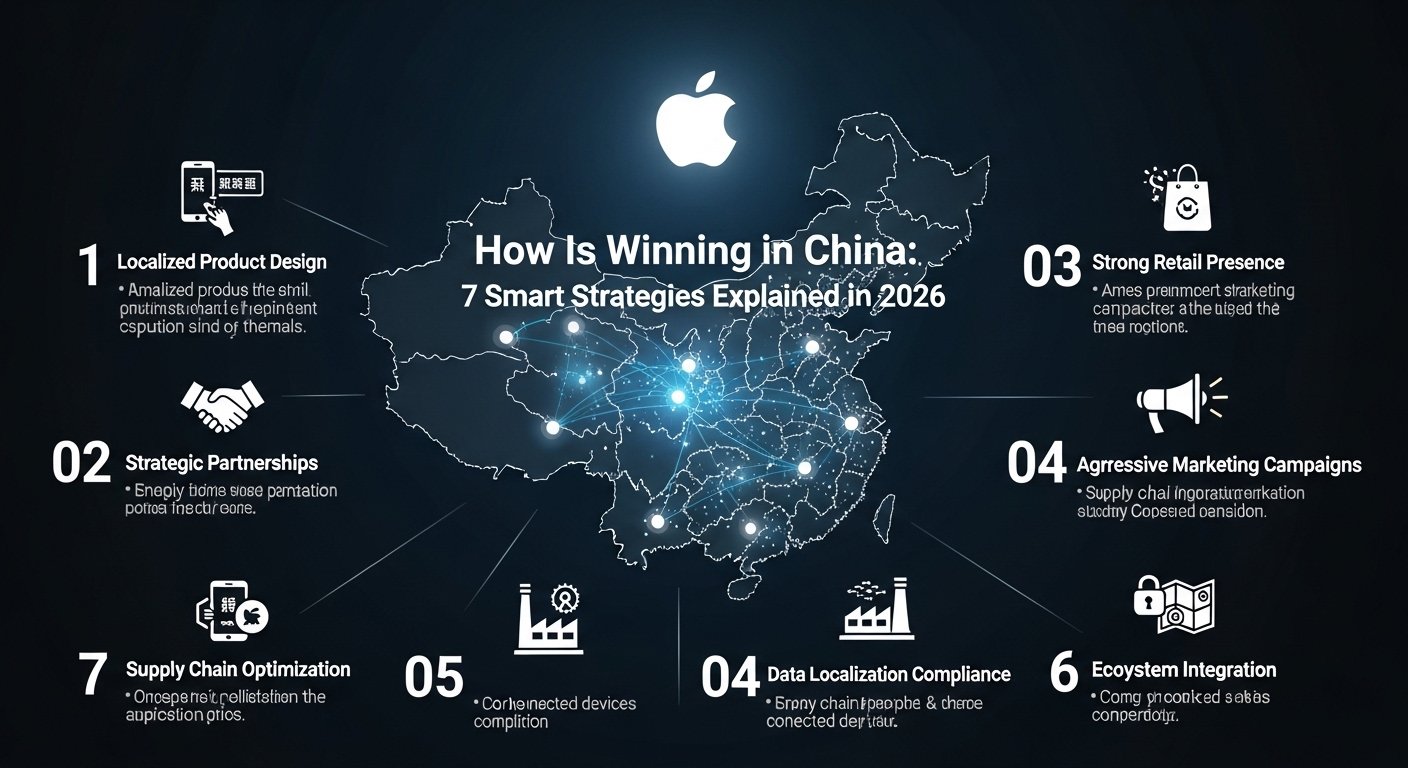
7 smart strategies
1. Apple is using price discipline instead of panic pricing
One of Apple’s smartest moves in China is staying disciplined on pricing while rivals are being pushed into uncomfortable price hikes. Counterpoint data cited by Yahoo Finance and News. Az says rising memory costs forced some Android manufacturers to raise prices, while Apple was expected to maintain its pricing strategy and absorb some margin pressure instead.
That gives Apple a major advantage in a price-sensitive market. When rivals become more expensive, Apple does not have to become cheap; it only has to become relatively more attractive.
This is especially powerful in a weak demand environment. A premium brand that avoids big price shocks can suddenly look like the safer buy when competitors are raising prices on key models.
2. It is using selective discounts, not brand-damaging discounting
Apple has also shown that it is willing to bend on price in China when needed, but in a controlled way. Entrepreneur reported earlier that Apple shifted from a rigid global premium-pricing approach toward more aggressive discounting in China to respond to local competition and changing demand conditions.
That flexibility appears to be paying off. Yahoo Finance reported that Apple’s 2026 sales growth in China was boosted by e-commerce deals, while MacRumors said strong growth in Q1 2026 was driven partly by promotional price cuts.
This is a smart balance. Apple is not turning the iPhone into a bargain product; it is using tactical discounts to protect momentum without destroying its premium image.
3. Apple is taking full advantage of e-commerce and subsidy timing
Another reason Apple is winning in China is that it is matching its sales strategy to how Chinese consumers actually buy phones. Yahoo Finance reported that Apple’s strong early-2026 sales were supported by e-commerce deals and government subsidies for the base model of the iPhone 17.
That matters because modern China’s smartphone demand is shaped heavily by timing, platform promotions, and online channel execution. Apple is no longer relying only on its premium image or physical stores; it is using online promotions and subsidy eligibility to widen the iPhone’s reach without fully repositioning the brand downward.
This strategy also helps Apple compete more effectively against brands that are traditionally stronger in aggressive online retail. By fitting itself into China’s e-commerce rhythm, Apple improves conversion without looking desperate.
4. The iPhone 17 lineup is giving buyers a real reason to upgrade
A strong product still matters, and Apple’s current product cycle is clearly helping. MacRumors said the iPhone 17 lineup was the main driver of Apple’s comeback in China, with the series accounting for about 20% of Apple’s shipments there in Q4 2025 and demand being particularly concentrated in the Pro models.
That tells us something important about Apple’s China strength. The company is not growing only through discounts or channel tricks; it is also benefiting from genuine product demand, especially among higher-end buyers who still want premium models.
This is a major edge in a market where many consumers are delaying upgrades. If your lineup feels desirable enough to trigger replacement demand in a slowing market, you gain share even when total market volume is flat or falling.
5. Apple’s supply chain control is stronger than many rivals’
Supply chain discipline may be the most underrated part of Apple’s success in China
