
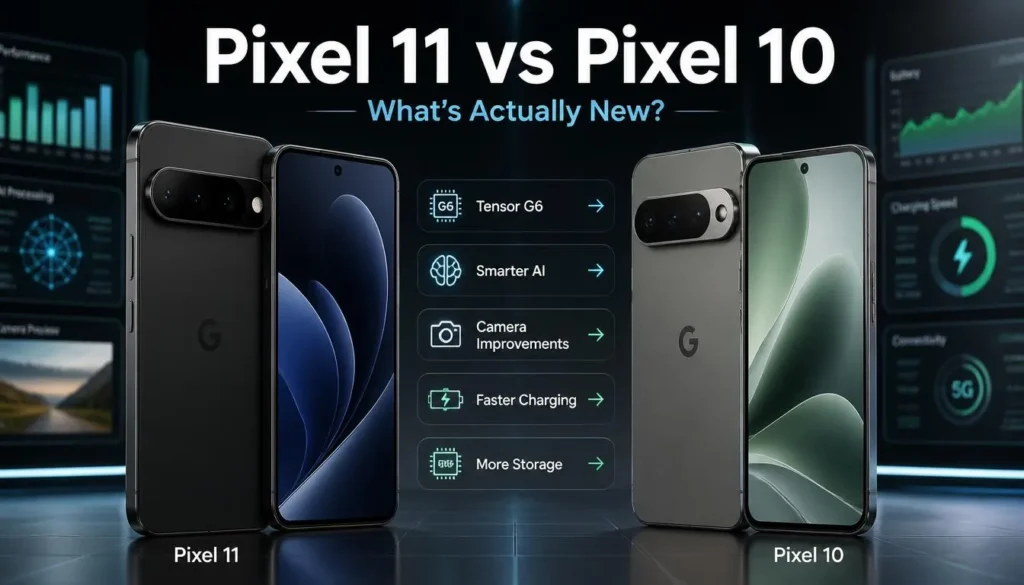
Pixel 11 vs Pixel 10: What’s Actually New
If you already own a Pixel 10 and are wondering whether the Pixel 11 is worth the jump, here’s the short version: it depends far less on hardware than you’d expect from a new phone generation. Google’s latest release is one of the more incremental updates in the Pixel line’s history, so whether that matters to you comes down to looking past the marketing and straight at the numbers.
This comparison is for one specific type of reader: someone deciding whether to buy a Pixel 10 at a lower price right now or pay more for the Pixel 11. It’s not for someone coming from a three-year-old phone, where almost any current flagship would feel like an upgrade. We’ll walk through where the two phones genuinely differ, where they’re functionally identical, and who each one actually makes sense for.
The Core Decision
Both phones share the same screen size, the same RAM configuration, and a camera system that’s more similar than different. The Pixel 11 pulls ahead in chip efficiency, storage, wireless charging speed, and software longevity, while the Pixel 10 pulls ahead on price and immediate availability at a discount now that it’s the outgoing model.
Deciding between the Pixel 11 and Pixel 10 really comes down to how much you value the newest chip and two extra years of guaranteed updates versus saving $100 to $150 on a phone that still does almost everything the same way.
Full Spec Comparison
Source data compiled from Google’s official specifications and comparisons published by Android Central, PhoneArena, and MobileSyrup.
Where the Difference Actually Matters
Chip and Modem
The move from Tensor G5 to Tensor G6 is the closest thing to a genuine generational leap here. Google shrank the process node from 3nm to 2nm, which typically means better power efficiency even when raw performance gains are modest. More significant for day-to-day use is the modem switch, from Samsung’s Exynos modem on the Pixel 10 to a MediaTek M90 on the Pixel 11
Pixel phones have had a rocky history with modem reliability and connectivity quirks, so a modem change is worth paying attention to even if it doesn’t show up on a spec sheet in an exciting way. It won’t be obvious in daily use unless you’ve dealt with dropped calls or slow handoffs between networks on a Pixel before.
Storage, Not RAM
Both phones ship with 12GB of RAM, so multitasking and app-switching performance should feel comparable in most situations. The real difference is storage: the Pixel 10 starts at 128GB, while the Pixel 11 doubles that starting point to 256GB.
That’s a meaningful shift if you shoot a lot of 4K video or keep a large offline media library, since it removes the cheapest, most storage-constrained option from the lineup entirely. If 128GB was always going to feel tight for you anyway, this changes the math on what you’re actually paying for.
Camera Hardware Versus Camera Software
The rear camera array is nearly identical on paper: both phones have a 48-megapixel main sensor, a 13-megapixel ultrawide, and a 10.8-megapixel 5x telephoto lens. The Pixel 11’s main sensor is physically larger, which should help slightly with low-light performance, and Super Zoom now reaches 30x instead of 20x.
The real photography upgrade shows up in software, not hardware. Features like Magic Capture and expanded Camera Looks modes are exclusive to the Pixel 11 generation, and early reviews suggest that’s where most of the year-over-year improvement in actual photo quality comes from, rather than the sensor itself.
Battery and Charging
Battery capacity moved from 4,970mAh to 4,985mAh, a difference so small it’s unlikely to be noticeable in daily use. Wired charging speed stayed flat at 30W on both phones, which several reviewers have already flagged as disappointing given how far competitors have pushed charging speeds this year.
Wireless charging is where the Pixel 11 pulls ahead more clearly, jumping from 15W to 25W with Qi2 support. If you rely on a wireless charging pad or stand at your desk, that’s a real quality-of-life improvement, not a marketing footnote.
Software Support Window
This is arguably the most concrete reason to lean toward the Pixel 11 if long-term value matters to you. Both phones get seven years of guaranteed OS and security updates from their respective launch dates, but because the Pixel 11 launched a full year later, its support window naturally extends a year further into the future .
The Pixel 11 also ships with Android 17 out of the box, while Pixel 10 units need an update to get there, though that update is already rolling out and takes little time to apply.
Price Difference, in Real Terms
The Pixel 10 launched at $799 for the 128GB configuration, with a 256GB version priced at $899. The Pixel 11 starts at $899 for 256GB, so a dollar-for-dollar comparison at matching storage tiers is roughly a wash, not the full $100 gap it might look like at first glance.
The price difference becomes real when you compare the cheapest available configuration of each phone. A 128GB Pixel 10 at $799 versus a 256GB Pixel 11 at $899 is genuinely a $100 gap, but it comes with double the storage.
Verdict: Pixel 10
The Pixel 10 remains a strong choice if your priority is saving money without sacrificing much in daily performance. Camera hardware, screen quality, and RAM are close enough to the Pixel 11 that most people won’t notice a difference in typical use. As retailers discount it further now that it’s the previous generation, it becomes an increasingly easy recommendation for budget-conscious buyers.
The trade-off is a shorter software support window and wired charging and modem speeds that are a generation behind. If neither matters much for how you use your phone, the savings are hard to argue with.
Verdict: Pixel 11
The Pixel 11 makes more sense if you plan to keep your phone for several years and want the longest possible update runway, or if the faster wireless charging and larger base storage solve a real annoyance you had with a previous Pixel. The new modem is also a reasonable hedge against the connectivity issues Pixel phones have occasionally struggled with in past generations.
It’s a harder sell if you already own a Pixel 10, since nothing here is dramatic enough to justify replacing a phone that’s barely a year old. The improvements are additive rather than transformative.
READ ALSO: Google Pixel 11 Review: What Every Major Outlet Says
Best For Each Type of Buyer
-
Budget-conscious upgraders coming from a Pixel 7 or older: the discounted Pixel 10 offers nearly identical performance to the Pixel 11 for less money.
-
Heavy photo and video shooters: the Pixel 11’s larger base storage and improved Super Zoom make it the more practical pick.
-
Anyone who charges wirelessly at a desk or nightstand: the jump to 25W Qi2 charging on the Pixel 11 is a genuine, noticeable convenience.
-
Current Pixel 10 owners: there’s little reason to switch this cycle; the differences are too incremental to justify the cost.
-
Buyers planning to keep their phone five-plus years: the Pixel 11’s extended software support window makes it the safer long-term investment.
The Bottom Line
Choosing between the Pixel 11 vs Pixel 10 isn’t really about finding a better phone, since both are strong performers built on the same design philosophy. It’s about whether a new modem, faster wireless charging, more storage, and an extra year of software updates are worth the price difference for you.
For most current Pixel 10 owners, sticking with what you have is the sensible move. For new buyers choosing between the two right now, the Pixel 11 is the more future-proof option, but the Pixel 10 is far from an outdated choice at its current price.