
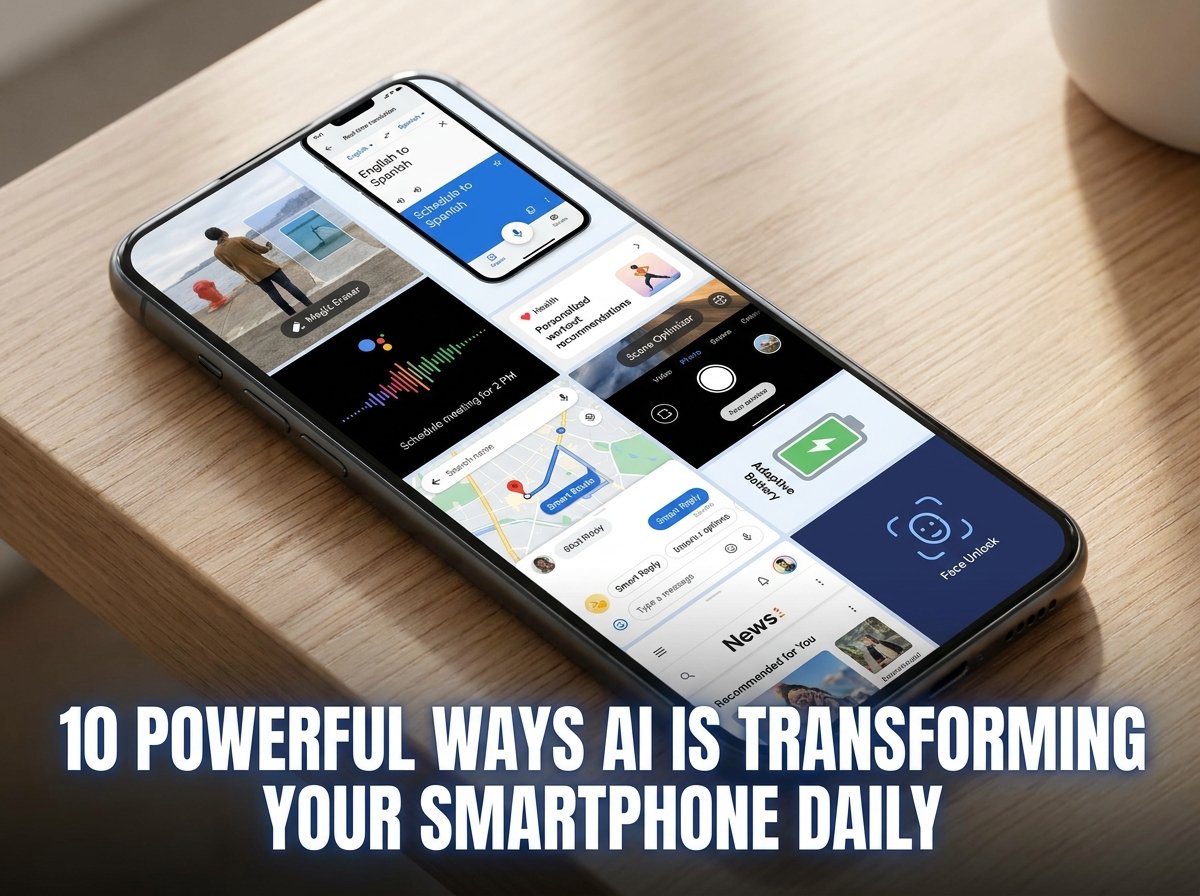
10 Powerful Ways AI Is Transforming Your Smartphone Daily in 2026
Smartphones already feel essential, but artificial intelligence is quietly turning them into something much more useful. What once required manual effort now happens automatically in the background. Your phone can improve photos, predict what you want to type, filter spam calls, translate speech, and even stretch battery life based on your habits.
That is why the topic of 10 powerful ways AI is transforming your smartphone daily matters so much in 2026. AI is no longer a futuristic buzzword or a feature limited to premium tech demos. It is becoming the invisible layer that makes everyday smartphone use faster, smoother, and more personal.
In this guide, you will learn how AI is changing the way people use their phones every day, why these changes matter, and which features offer the most practical value. Whether you use Android or iPhone, understanding these AI upgrades can help you get more from the device already in your pocket.
Table of Contents
-
What AI in smartphones really means
-
10 powerful ways AI is transforming your smartphone daily
-
Why this matters for everyday users
-
How to use smartphone AI wisely
-
FAQ
-
Conclusion
What AI in Smartphones Really Means
When people hear “AI,” they often think of chatbots or image generators. But smartphone AI is much broader than that. It includes machine learning, on-device intelligence, voice recognition, predictive systems, visual processing, and smart automation.
In simple terms, smartphone AI means your device can learn patterns, understand context, and make useful decisions faster than a normal software system. Instead of waiting for you to do everything manually, it can anticipate needs, optimize performance, and simplify repeated tasks.
This shift matters because it changes the smartphone from a tool you fully control into a device that actively helps you. Good AI does not make your phone feel complicated. It makes the phone feel easier.

1. AI Makes Smartphone Photography Much Better
One of the clearest examples of the 10 powerful ways AI is transforming your smartphone daily is mobile photography. Modern smartphones no longer rely only on camera hardware. AI now plays a major role in how photos are captured, processed, and improved.
When you take a picture, AI can instantly detect faces, lighting conditions, objects, motion, and background depth. Then it adjusts contrast, exposure, color tone, sharpness, and noise reduction in real time. This is why many people can capture excellent photos without knowing anything about photography.
For example, night photos used to look dark, blurry, or grainy. Now AI helps brighten scenes, reduce noise, and recover detail. Portrait mode is another example. Instead of needing a professional camera lens, your phone uses AI to separate the subject from the background and create a more polished look.
This matters because people want better results with less effort. AI delivers exactly that.
2. AI Improves Battery Life Without You Noticing
Battery life is one of the biggest frustrations for smartphone users. AI helps solve that by learning how you use your device throughout the day.
If you always open certain apps in the morning, use maps in the afternoon, and watch videos at night, your phone can recognize those patterns. It can then reduce power to apps you rarely use, limit unnecessary background activity, and prioritize the features that matter most to you.
This creates a smarter battery system instead of a one-size-fits-all approach. Two people can own the same phone and get different battery results because AI adapts to personal habits.
That is one reason 10 powerful ways AI is transforming your smartphone daily is not just about flashy features. Some of the most useful changes happen behind the scenes, and better battery management is one of them.
3. AI Makes Voice Assistants More Useful
Voice assistants used to feel limited. They could handle basic alarms or weather questions, but they often struggled with natural conversation. AI has changed that.
Today’s smartphone assistants are better at understanding context, follow-up questions, and everyday language. Instead of speaking like a robot to your phone, you can talk more naturally. This makes voice control more useful while driving, cooking, walking, or multitasking.
For example, you might say:
-
“Text Sarah that I’ll be 10 minutes late.”
-
“Remind me to send that invoice when I get home.”
-
“What’s the best route if traffic gets worse?”
These are practical tasks, not gimmicks. The better AI becomes, the more your phone starts acting like a real assistant rather than a voice command machine.
4. AI Helps You Type Faster and Better
Typing is one of the most repeated smartphone actions, so even small AI improvements matter a lot. Smart keyboards now use AI for autocorrect, predictive text, grammar help, tone adjustment, and sentence completion.
This saves time, especially for people who send many emails, messages, or social posts every day. AI can spot common typing errors, suggest the next word, and even help rewrite text to sound clearer or more professional.
Imagine you are replying to a work message quickly. Instead of typing everything manually, your phone may suggest a full response based on the conversation. That makes communication faster without forcing you to sacrifice quality.
For content creators, freelancers, and business users, this is one of the most valuable examples of how AI is transforming smartphone use in daily life.
5. AI Enhances Security and Fraud Detection
Security is another area where AI is becoming more important. Many people think only of face unlock or fingerprint scanning, but AI now contributes far more than that.
It can help detect unusual login attempts, suspicious app behavior, abnormal spending patterns, fake calls, phishing links, and spam messages. Some phones also use AI to analyze behavior patterns, such as how you type or hold the phone, to improve security without adding friction.
This is a major improvement because traditional security often depends on fixed rules. AI adds adaptability. It can identify patterns that look risky even before a clear threat is confirmed.
In a world where scams and digital fraud keep evolving, this is one of the strongest reasons AI belongs on smartphones.
6. AI Powers Real-Time Translation and Transcription
Language used to be a major barrier in travel, work, and online communication. AI is reducing that barrier every day.
Your smartphone can now translate signs, menus, chats, emails, and even live conversations much faster than before. It can also transcribe spoken words into text during meetings, voice notes, interviews, or lectures.
This is especially useful for:
-
Travelers navigating unfamiliar countries
-
Students recording classes
-
Remote workers joining international calls
-
Small business owners communicating with global clients
Real-time translation is one of the most practical parts of 10 powerful ways AI is transforming your smartphone daily because it solves a real problem instantly. It helps people understand and be understood.
7. AI Personalizes What You See and Use
Smartphones are becoming more personal because AI studies what matters to each user. This affects app suggestions, notification priorities, music recommendations, news feeds, widgets, and even home-screen behavior.
For example, if you open a food delivery app every Friday evening, your phone may surface that app earlier. If you ignore certain notifications often, AI may reduce its visibility. If you always call one person at a certain time, your phone may predict that action.
This personalization makes the device feel faster because the right information appears at the right moment. It also reduces clutter.
Of course, personalization should be balanced with privacy, but when done well, it improves daily convenience in a meaningful way.
8. AI Improves Search and On-Screen Understanding
Search is no longer just about typing words into a search bar. Smartphone AI now helps users search for what they see, hear, and read on screen.
This includes visual lookup, object recognition, screenshot analysis, and context-aware search tools. You can search for a product from an image, copy text from a photo, identify a landmark, or ask your phone about something shown in a video.
This is powerful because it reduces the gap between curiosity and action. Instead of switching apps, retyping text, or manually describing something, AI lets your phone understand the context directly.
For everyday users, this creates a smoother experience. For online shoppers, students, and researchers, it can save a surprising amount of time.
9. AI Supports Health, Wellness, and Fitness Tracking
Smartphones and connected devices now use AI to offer smarter health insights. This includes activity tracking, sleep analysis, stress patterns, workout suggestions, heart-rate trends, and wellness reminders.
The real benefit is not just collecting data. AI helps turn raw information into useful guidance. For instance, instead of showing only steps walked, your phone or wearable may highlight that your sleep dropped this week, your recovery is weaker, or your routine changed.
This can help users make better decisions without feeling overwhelmed by numbers. It also encourages consistency, which is often more important than perfection in health and fitness.
While AI is not a replacement for medical advice, it can become a useful everyday wellness tool when used responsibly.
10. AI Improves Accessibility for More People
One of the most meaningful examples of the 10 powerful ways AI is transforming your smartphone daily is accessibility. AI is helping smartphones become easier to use for people with different needs, abilities, and limitations.
This includes:
-
Voice control for hands-free use
-
Live captions for audio and video
-
Screen readers with better context
-
Image descriptions for visually impaired users
-
Speech-to-text tools for people with hearing difficulty
-
Smarter interface adjustments based on user behavior
These are not niche upgrades. They improve inclusion and independence. Many accessibility tools also become useful to mainstream users, which shows how good design benefits everyone.
For example, live captions help not only people with hearing loss, but also anyone watching videos in a noisy place or a quiet office.
Why These AI Changes Matter in Real Life
The biggest reason smartphone AI matters is simple: it saves time and reduces effort.
People do not wake up wanting more technology. They want easier photos, clearer communication, fewer scams, better battery life, and less friction. AI becomes valuable when it solves those daily problems quietly and consistently.
That is why the phrase 10 powerful ways AI is transforming your smartphone daily describes a real shift in behavior, not just a marketing trend. The phone is becoming more adaptive, more aware, and more helpful in small moments that add up over time.
For many users, the future of AI will not be one dramatic breakthrough. It will be hundreds of tiny improvements that make everyday life smoother.
How to Use Smartphone AI Wisely
AI features can be useful, but they work best when users stay intentional. Here are a few smart habits:
-
Review privacy settings regularly.
-
Turn off AI features you do not actually use.
-
Double-check AI-generated writing before sending it.
-
Do not rely on AI alone for medical, legal, or financial decisions.
-
Use AI as a helper, not a replacement for judgment.
-
Keep your device updated so security and AI features improve over time.
This balanced approach helps you enjoy the benefits of AI without becoming overdependent on automation.
Quick Comparison of Daily AI Benefits
FAQ
1. What is smartphone AI in simple words?
Smartphone AI is technology that helps your phone learn patterns, understand context, and automate useful tasks such as photography, typing, battery management, and voice control.
2. Is AI on smartphones only for expensive flagship devices?
No. Premium phones usually get advanced AI features first, but many useful AI tools also appear on mid-range smartphones over time.
3. Does AI improve battery life?
Yes. AI can help extend battery life by learning your habits, limiting background activity, and allocating power more efficiently.
4. Is AI in smartphone cameras really that important?
Yes. AI now plays a major role in image quality by improving exposure, night mode, portraits, detail, and motion handling.
5. Can AI make smartphones safer?
Yes. AI can help detect spam, suspicious activity, phishing attempts, and unusual behavior patterns that may signal security risks.
6. What is the biggest everyday benefit of smartphone AI?
For most people, the biggest benefit is convenience. AI helps save time, reduce manual effort, and improve common tasks such as messaging, search, photos, and battery use.
7. Should I trust every AI feature on my phone?
No. AI is helpful, but it is still important to review suggestions, protect your privacy, and use your own judgment.
Conclusion
The best way to understand 10 powerful ways AI is transforming your smartphone daily is to look at what your phone already does better than it did a few years ago. Photos look sharper, typing feels faster, assistants sound smarter, translation is easier, and battery life is more efficient. These are not small upgrades. They change how people use their devices every day.
AI is not making smartphones magical. It is making them more practical.
That is the real story in 2026. The phones in our pockets are becoming more adaptive, more personal, and more useful in ways that feel natural instead of forced. For users, that means less friction and more value from the device they already depend on every single day.
