
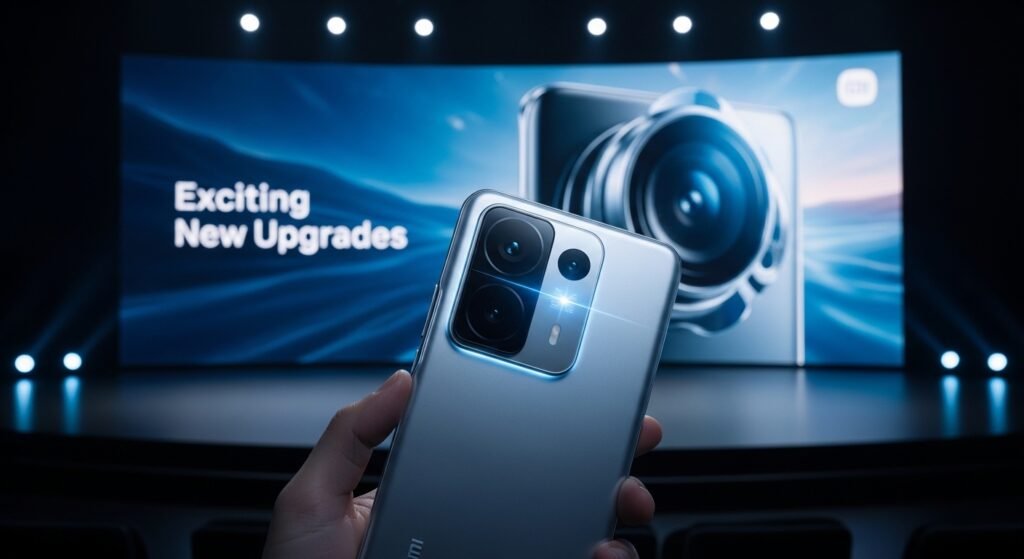
Xiaomi camera innovations 2026: modular system, Light Hunter 900, and AI that redefine mobile photography
Xiaomi’s camera innovations in 2026 solve real smartphone photography problems. They include modular external lenses, custom Light Hunter sensors, and AI that rivals dedicated cameras. These changes push Xiaomi ahead in imaging.
Xiaomi Time lists eight innovations that redefined mobile photography. They range from variable aperture to AI Focus. Uitech’s report describes a Modular Optical System scheduled to launch in 2026. This system attaches a Micro Four Thirds sensor and a 35mm f/1.4 lens to the phone.
These features target creators and enthusiasts. They address space limits and processing power. Xiaomi combines hardware with AI pipelines.

Modular Optical System: external pro optics
Xiaomi’s Modular Optical System debuted at MWC 2025. It will enter production in 2026.
Key specs:
-
Micro Four Thirds sensor (up to 100 MP).
-
35mm f/1.4 lens.
-
LaserLink for 10 Gbps data transfer.
-
Power from phone via pogo pins.
The module captures raw data. The phone handles AI processing. This bypasses smartphone size limits.
It supports depth‑of‑field and optical correction. The phone’s AISP recognizes the module. This creates real bokeh with glass optics.
Light Hunter 900: custom sensor breakthrough
Xiaomi’s Light Hunter 900 debuted in Xiaomi 14. It is a custom OVX9000 sensor. OmniVision and Xiaomi co‑developed it.
Features:
-
13.5 EV dynamic range (vs 10.5 EV for IMX989).
-
Dual ISO Fusion Max.
-
Native HDR.
-
50% better noise reduction.
-
+180% light sensitivity.
GizChina confirms it uses OV50H technology. It enables Leica variable aperture.
This sensor prioritizes low light. It reduces watercolor artifacts. Xiaomi tunes it for Leica color science.
Light Fusion 900: Xiaomi 14’s imaging heart
Xiaomi India highlights Light Fusion 900 as the core of Xiaomi 14’s Leica system. It captures emotions with detail.
Benefits:
-
High light capture.
-
Light control mastery.
-
Leica Summilux optics.
Xiaomi 14 Pro adds a variable f/1.42‑4.0 aperture. This controls depth‑of‑field.
Variable aperture: pro lens control
Xiaomi 13 Ultra and 14 Ultra introduced a f/1.63‑4.0 aperture. It mimics DSLR lenses.
Advantages:
-
Manual bokeh control.
-
Better low‑light performance.
-
Depth adjustment.
Xiaomi 14 Pro offers f/1.42‑4.0. This expands creative options.
Xiaomi ProFocus: AI motion tracking
Xiaomi ProFocus uses AI for eye and motion tracking. It rivals Sony Alpha cameras.

Capabilities:
-
Accurate subject tracking.
-
Motion prediction.
-
Low‑light focus lock.
Xiaomi 13/14 Ultra implements it. It excels in portraits and sports.
Leica partnership: optics and algorithms
Xiaomi’s Leica collaboration started with Xiaomi 13. It continues into 2026.
Outcomes:
-
Summilux lenses.
-
Tuned color science.
-
Variable aperture optics.
Xiaomi 14 pairs Light Hunter 900 with Leica. This creates mobile imaging leadership.
AI Image Signal Processor (AISP): computational power
AISP handles modular data. It processes RAW files instantly.
Features:
-
Real‑time calibration.
-
Depth calculation.
-
Optical correction.
This enables pro workflows. It integrates with Xiaomi’s AI stack.
200 MP zoom and continuous optical zoom
Xiaomi 16 Ultra rumors mentiona 200 MP zoom camera. It offers continuous optical zoom.
Details:
-
Smooth zoom from 3x to 10x.
-
High‑resolution sensor.
-
No zoom gaps.
Guru3D calls it a departure from quad setups. It focuses on Zoom excellence.
Comparison table: Xiaomi’s 2026 camera innovations
| Innovation | Key feature | Benefit |
|---|---|---|
| Modular Optical System | Micro Four Thirds + 35mm f/1.4 | Pro optics without a camera body |
| Light Hunter 900 | 13.5 EV dynamic range | Superior low light, noise reduction |
| Variable aperture | f/1.42‑4.0 | Manual bokeh, light control |
| ProFocus AI | Eye/motion tracking | Accurate focus in portraits/sports |
| Leica Summilux | Custom optics | Premium color, sharpness |
| AISP processing | 10 Gbps LaserLink | Instant RAW handling |
| 200 MP continuous zoom | Smooth 3x‑10x | Zoom without quality loss |
Read Related Article
Xiaomi 16 Pro: specs and release date
FAQ
What is Xiaomi’s Modular Optical System?
It attaches a Micro Four Thirds sensor and a 35mm f/1.4 lens to the phone. LaserLink transfers data at 10 Gbps. The phone processes RAW files.
What makes Light Hunter 900 special?
It offers 13.5 EV dynamic range. Dual ISO Fusion Max adds native HDR. It reduces noise by 50%. Light sensitivity improves +180%.
How does variable aperture work on Xiaomi phones?
Xiaomi 13/14 Ultra uses f/1.63‑4.0. Xiaomi 14 Pro goes f/1.42‑4.0. It controls depth‑of‑field like DSLRs.
What is Xiaomi ProFocus?
AI‑powered eye and motion tracking. It matches Sony Alpha accuracy. Great for portraits and action shots.
Will Xiaomi’s 200 MP zoom camera launch in 2026?
Rumors point to Xiaomi 16 Ultra. It offers continuous optical zoom. Smooth from 3x to 10x