
7 powerful iPhone performance upgrades coming in 2026: what changes, what stays the same, and who should wait for iPhone 18
iPhone performance in 2026 is no longer just about how fast apps open. It’s about how well the device sustains that performance during gaming, video editing, and on-device AI, how efficiently it uses power, and how smoothly it multitasks without heat or battery penalties. Apple already laid a strong foundation with the A19 Pro chip in the iPhone 17 Pro line, explicitly tying design to sustained performance and cooling rather than only peak benchmark numbers.
The next step is rumored to be the A20 generation in the iPhone 18 family, which multiple reports say will move to a 2nm manufacturing process and deliver a noticeable jump in both speed and efficiency. That shift has implications across everything from gaming to large language models running locally. The goal of this guide is to explain those upgrades clearly, separate credible expectations from marketing hype, and help different types of users decide whether to buy now or wait.
1. The A20 2nm chip: the biggest leap in years
Several independent rumor sources indicate that Apple’s next flagship iPhone chip (expected as A20 for the iPhone 18 family) will move from 3nm to a more advanced 2nm process at TSMC. Reports summarized by PhoneArena and Notebookcheck suggest this shift could bring roughly 10–15% higher performance with around 20–30% lower power consumption compared to A19. Apple Scoop’s coverage of analyst Ming-Chi Kuo’s comments similarly frames a 15% performance boost and up to 30% better efficiency versus A19.
Why this matters in practice:
-
Heavy tasks (3D games, 4K video edits, complex photo processing) complete faster and with fewer slowdowns.
-
The phone can stay cooler under sustained load because it wastes less energy as heat.
-
Battery life improves not only by adding capacity but by doing more with each mAh.
For users on older devices (A16 or earlier), the step to a 2nm A20 is likely to feel more dramatic than the typical “small bump” year-to-year upgrades.
2. From burst performance to sustained performance: how Apple changed the baseline
Performance used to be discussed mostly in terms of short benchmark bursts. Apple has been shifting the narrative toward sustained performance—how long a phone can hold high speed before throttling due to heat. A Forbes interview with Apple design and silicon executives about iPhone 17 Pro describes an “inside-out” design with a new vapor chamber cooling system and a 7000‑series aluminum architecture chosen specifically to dissipate heat and enable up to 40% better sustained performance than the previous Pro generation.
That context is important for 2026:
-
The A19 Pro already delivers strong, sustained performance with help from the new thermal system.
-
A20 at 2nm is expected to push this further, with efficiency gains that let the phone maintain high performance for longer under the same thermal envelope.
For users who game, edit, or run local AI workloads, sustained performance is the real upgrade, not just a benchmark spike.
3. On-device AI and LLMs: performance that feels smarter, not just faster
Apple has already tied iPhone performance to local AI workloads. In its iPhone 17 Pro press release, Apple says A19 Pro’s CPU, GPU, and Neural Engine work together to run “large local language models” and enable hardware‑accelerated ray tracing in AAA games. The Forbes design interview reinforces this, noting that the thermal architecture was designed with on-device LLMs in mind, not just games.
Rumors around A20 suggest:
-
More transistors and higher efficiency at 2nm allow for larger, more capable models to run locally.
-
AI-heavy features (voice, camera, suggestions, smart photo/video tools) can be more responsive and less dependent on cloud calls.
Practical impact in 2026:
-
Faster on-device summarization, transcription, and search.
-
Image and video edits that apply complex effects with less waiting.
-
More privacy-friendly AI features because more can happen locally.
If AI features are a priority, the iPhone 18 generation looks like the inflection point where the hardware and software stack are both optimized for sustained local intelligence rather than occasional tricks.
4. Gaming, graphics, and display fluidity: what changes for players
The A19 Pro already includes a 6‑core GPU with per-core Neural Accelerators and hardware‑accelerated ray tracing, enabling console‑style effects such as realistic reflections and lighting in supported games. With that as a starting point, the rumored 10–15% performance bump and improved energy efficiency at 2nm give iPhone 18 more headroom.
Rumor roundups about iPhone 18 performance (including PhoneArena’s coverage of “10 big upgrades” and Reddit’s iPhone 18 discussion) also mention:
-
Expected LTPO+ panels for smoother visuals and better power use at high refresh rates on Pro models.
-
The ability to sustain high frame rates more consistently without aggressive thermal throttling.
For gamers, the upgrade will be felt in:
-
More stable frame rates during extended sessions.
-
Less device warmth during intense gameplay.
-
Better balance between battery drain and visual fidelity.
5. Battery life and efficiency: performance that drains less
The performance story in 2026 is tightly linked to battery efficiency. The Reddit “iPhone 18 Rundown” notes expectations of silicon‑carbon battery technology and denser battery packaging (“metal can” structures) that could increase capacity without enlarging the device, especially on Pro Max models—while potentially increasing weight. At the same time, Notebookcheck and Cult of Mac’s coverage of A20emphasizese that 2nm could deliver performance gains without raising power draw, or noticeably reduce power at similar performance levels.
This results in two overlapping gains:
-
Short-term battery life: tasks finish faster and at lower power, so per‑charge runtime improves.
-
Long-term battery health: cooler operation and less time spent at peak output can reduce wear.
For buyers who care about both speed and battery longevity, iPhone 18’s rumored A20 platform is significant: it seeks to avoid the usual tradeoff where more performance means more heat and faster drain.
6. Connectivity, modem performance, and multitasking: the quiet performance upgrades
Performance upgrades in 2026 are not limited to CPU and GPU. Rumor summaries—especially the detailed Reddit “iPhone 18 Rundown”—also talk about:
-
A potential in-house Apple 5G modem (referred to as a “C2 5G modem”) aiming for more efficient connectivity and reduced power draw.
-
More RAM on Pro models, with expectations of an increase from 8 GB to around 12 GB to help with multitasking and large models.
Why this matters:
-
A more efficient modem means less drain in poor signal conditions and fewer performance dips tied to heat from radios.
-
More RAM reduces app reloads and improves performance in workflows that juggle many large apps or browser tabs.
These are “invisible” upgrades in spec sheets but very visible in daily behavior, especially for people in areas with inconsistent coverage or those who run complex app stacks.
7. iPhone 18 vs iPhone 17 vs older models: performance comparison that matters in real life
How big is the jump from iPhone 17 to iPhone 18?
Apple’s own messaging says A19 Pro offers up to 40% better sustained performance than the previous Pro generation when paired with its new vapor chamber architecture. Rumors about A20 on a 2nm process add another layer: around 10–15% raw performance gains with 20–30% better efficiency compared to A19, according to Notebookcheck and Apple-focused rumor coverage.
This suggests a pattern:
-
iPhone 17 Pro already feels like a “big” performance and thermal jump.
-
iPhone 18 is likely to be more of a compound improvement—refining the new inside‑out design with a more advanced process node.
For owners of iPhone 17 Pro, the upgrade case will hinge more on camera, design, and specific AI features than raw speed. For owners of iPhone 15 or earlier, the combined A19/A20-era architecture likely represents a major uplift in speed, stability, and battery behavior.
How does it compare to Android flagships?
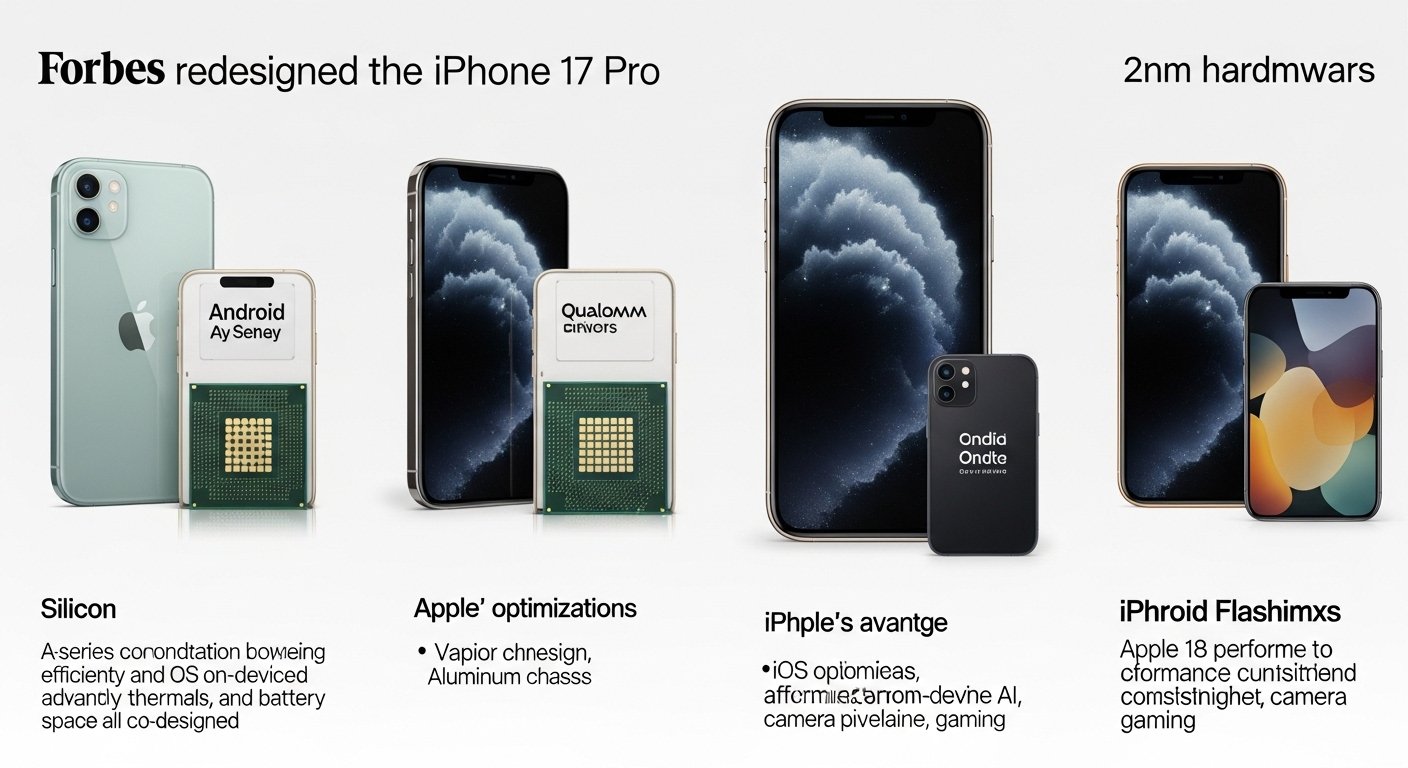
On the Android side, Qualcomm and others are also pushing efficiency and on-device AI performance at advanced process nodes. However, Apple’s advantage remains tight coordination between:
-
Silicon (A‑series chips).
-
OS (iOS optimizations).
-
Thermal design (vapor chamber, aluminum chassis).
-
Software features (on-device AI, camera pipeline, gaming).
The Forbes interview notes that Apple redesigned the iPhone 17 Pro “from the inside out,” with performance, thermals, and battery space all co-designed. If iPhone 18 continues this philosophy with 2nm hardware, Apple’s performance story in 2026 is less about having the single highest benchmark score and more about the most consistent performance across sustained tasks and AI-heavy workflows.
Should you wait for iPhone 18 for performance reasons?
Wait for iPhone 18 if:
-
You rely heavily on local AI, gaming, or video editing and want the best sustained performance and efficiency.
-
You are coming from an iPhone 14 or older and can comfortably use your current device until late 2026.
-
You care about battery life and want the combination of 2nm efficiency and Apple’s new thermal and battery design direction.
Buy an iPhone 17 (especially Pro) now if:
-
Your current phone is already limiting you (slowdowns, thermal throttling, poor battery, or unsupported OS).
-
You want a big performance and camera jump today and are comfortable skipping one generation.
-
You prefer proven designs and would rather avoid the first wave of any new strategy around splits, foldables, or radical design shifts.
For reference, Apple’s official iPhone 17 Pro press release is the clearest current look at how Apple frames CPU, GPU, Neural Engine, and thermal design working together:
https://www.apple.com/newsroom/2025/09/apple-unveils-iphone-17-pro-and-iphone-17-pro-max/
Read Related Article
iPhone battery improvements explained
FAQ
How much faster will the iPhone 18 be than the iPhone 17?
Rumor summaries and chip analysis suggest A20 at 2nm could be about 10–15% faster than A19 while using 20–30% less power, on top of the already strong A19 Pro gains in sustained performance.
Will iPhone 18’s performance mainly help gaming or everyday use?
Both. Games and heavy apps benefit from higher sustained performance and more efficient graphics, while everyday use benefits from better multitasking, quicker AI features, and less heat and battery drain.
Does iPhone 18’s rumored 2nm chip mean better battery life?
Yes, in principle: reports indicate that A20 at 2nm can deliver similar or higher performance at meaningfully lower power, which should translate into better battery life if Apple does not offset it with large feature demands.
Will older iPhones get the same AI features as iPhone 18?
Not necessarily. Apple already segments some capabilities by chip generation; more advanced on-device AI features typically require newer Neural Engine and GPU capabilities, so iPhone 18 is likely to run a broader set of local AI tasks than older devices.
Is it worth upgrading from iPhone 17 Pro to iPhone 18 for performance alone?
Probably not for most people. A19 Pro already delivers excellent sustained performance with strong thermals; for many, the iPhone 18 decision will depend more on camera, design, or AI feature exclusives than raw speed differences.