
Apple camera upgrades in 2026: what actually improved, what changed the least, and how to buy smarter.
Apple’s camera story in 2026 is less about one breakthrough spec and more about a full pipeline upgrade: sensors, lenses, stabilization, machine-learning processing, and pro video tools moving in the same direction. The result is a more consistent camera across lighting conditions and zoom ranges, plus features that increasingly target creators who treat an iPhone as a primary capture device rather than a “good enough” backup.
That shift matters because phone cameras now compete on reliability. The best camera phone is the one that nails focus quickly, holds skin tones steady across mixed lighting, avoids over-sharpening, and records clean, stable video with minimal setup. In 2026, Apple is pushing hard on exactly those areas, while also making the “camera choice” more tiered: standard iPhones aim for predictable, high-quality results, and Pro models add tools that look more like a compact cinema workflow than a casual phone feature set.
What Apple’s “camera upgrade” means in 2026
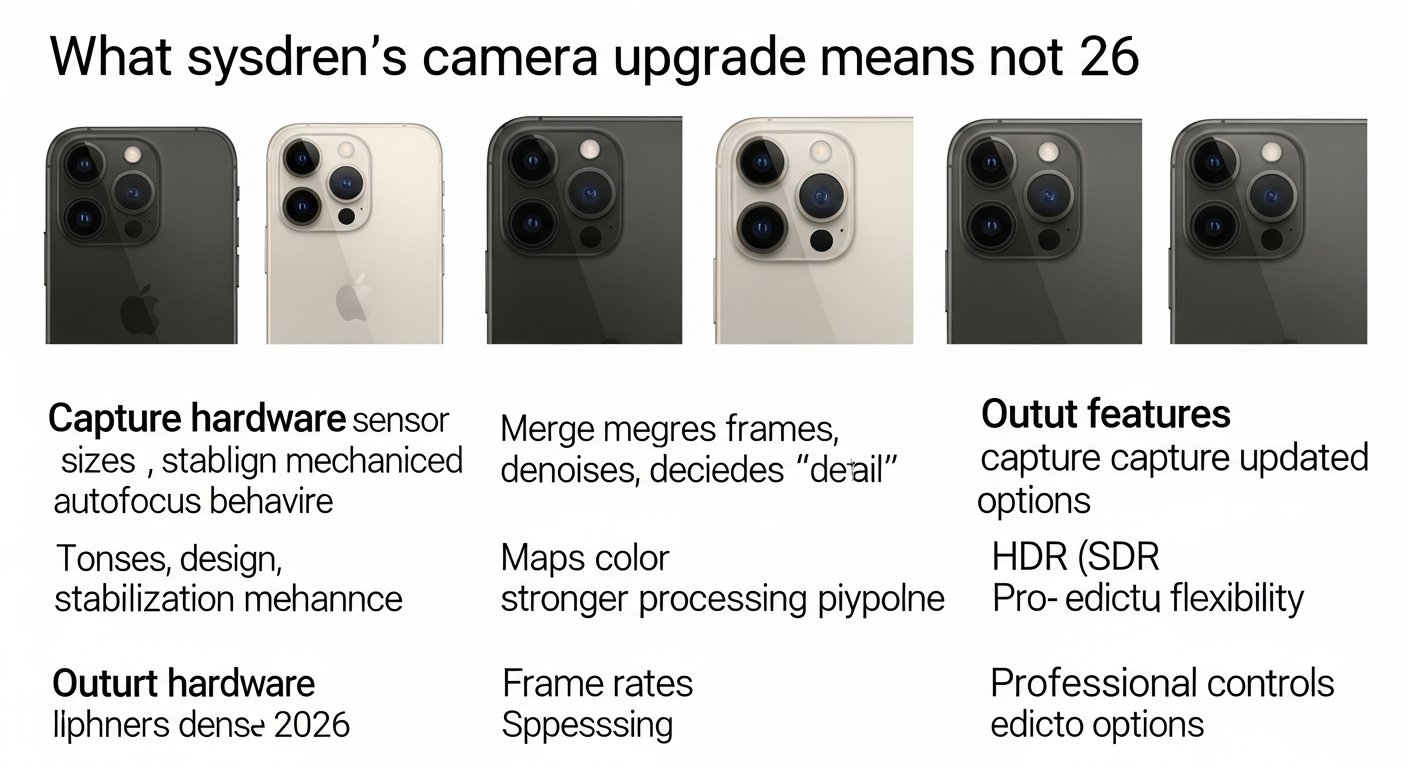
A modern iPhone camera system is a stack, not a single part. In practical use, Apple’s camera improvements tend to land in three places:
-
Capture hardware: sensor size, lens design, stabilization mechanics, autofocus behavior.
-
Image pipeline: how the iPhone merges frames, denoises, maps color, and decides what “detail” should look like.
-
Output features: formats, frame rates, HDR behavior, and pro-grade controls that affect editing flexibility.
In 2026, the most meaningful gains usually come from the interaction of these layers. A new sensor can be underwhelming with an unchanged processing pipeline, and a stronger processing pipeline can make an older sensor look surprisingly competitive. Apple’s recent launches highlight that “system thinking” approach: the iPhone 17 line is described as pairing updated cameras with updated processing, while the Pro line expands both capture hardware and professional video options.
The most visible 2026 camera changes on iPhone
Higher-resolution cameras are now more common, but that’s not the headline
Apple’s iPhone 17 announcement describes a 48MP Fusion Main camera with an “optical-quality 2x Telephoto” effect and a new 48MP Fusion Ultra Wide camera, positioning the upgrade around flexibility and detail rather than pure megapixel marketing.
The same press release also states that iPhone 17 features “all 48MP rear cameras for the first time,” framing this as a consistency upgrade across the rear system, not a single-lens bump.
What this usually means for real photos:
-
More room to crop without falling apart instantly.
-
Better detail retention in good light.
-
Less “watercolor” texture in complex scenes (hair, leaves, fabrics) when processing is tuned well.
Where it may not help much:
-
Very low light if the processing chooses heavy denoising.
-
Fast motion if exposure and frame merging are not well balanced.
-
Social-media compression can erase the gains of greater native detail.
Apple is leaning into better selfie video and framing
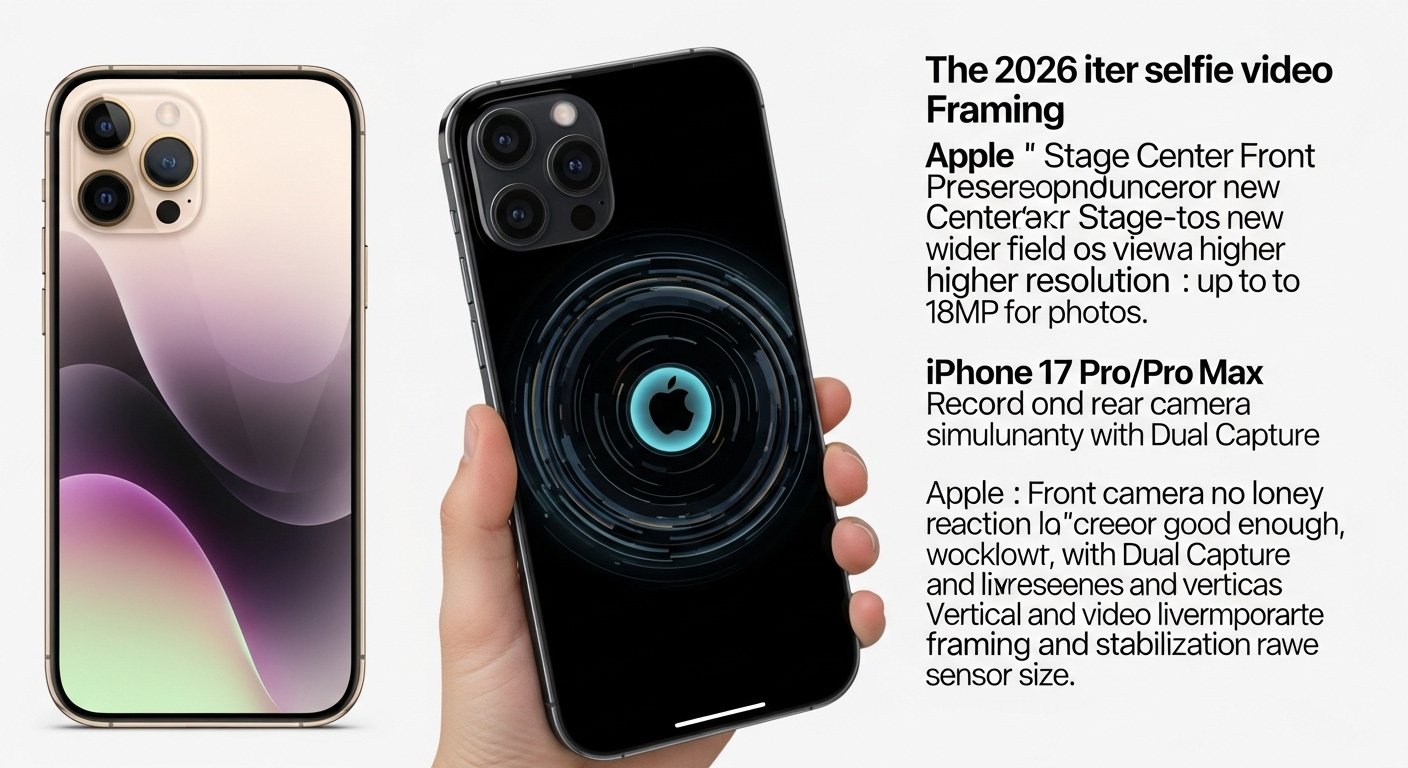
Apple’s iPhone 17 press release puts real emphasis on a new Center Stage front camera and calls out a wider field of view and higher resolution “up to 18MP for photos.”
Apple’s iPhone 17 Pro/Pro Max press release describes the same Center Stage front camera and adds that users can record on front and rear cameras simultaneously with Dual Capture, which is directly relevant for creators and behind-the-scenes content.
The 2026 angle: front cameras are no longer treated as a “good enough” checkbox. They’re increasingly part of a creator workflow, reaction shots, commentary, live streams, and vertical vide,o where framing and stabilization are more important than raw sensor size.
The real upgrade is often machine learning in the pipeline
In the iPhone 17 Pro/Pro Max announcement, Apple explicitly says the updated Photonic Engine uses more machine learning “to preserve natural detail, reduce noise, and provide significantly improved color accuracy.”
That is the kind of statement that explains why two phones with similar megapixels can still produce different-looking photos: processing decisions shape texture, highlights, skin tones, and noise more than most spec sheets suggest.
For buyers, this is a key roadmap lesson: if a camera upgrade is described mainly through the pipeline (machine learning, Photonic Engine, color accuracy), the improvement may apply across multiple lenses and scenarios. If it’s described mainly as “new sensor,” the gains may be limited to one focal length.
What’s new for iPhone video creators in 2026
Apple’s Pro iPhones in 2026 are increasingly positioned as production tools. In Apple’s iPhone 17 Pro/Pro Max press release, Apple highlights “industry-first video features” including ProRes RAW, Apple Log 2, and genlock.
The same announcement also describes these features as aimed at filmmakers and content creators and discusses workflow compatibility (including genlock synchronization and support through accessories and apps).
What changes in real life:
-
Log capture improves grading flexibility (more control in editing).
-
ProRes RAW targets higher-end workflows that want more data from the sensor.
-
Genlock and synchronized capture are niche, but meaningful for multi-camera setups and professional shoots.
What it does not change:
-
Most people filming family events or quick clips will still be better served by default HDR modes and simpler settings.
-
A phone cannot fully replace dedicated cameras for certain lenses, sensor sizes, and manual control needs—but the gap is narrower when the phone supports creator-oriented formats.
Comparison: Apple’s 2026 camera strategy vs rivals (and older iPhones)
Apple’s approach in 2026 can be summarized as “consistency + pipeline + creator tools,” while many rivals often compete more aggressively on periscope zoom ranges, extreme megapixel sensors, or heavier AI look changes. The best choice depends on taste as much as technology: some users prefer a more processed, punchy look; others prioritize natural detail and stable color.
Versus older iPhones (the upgrade question that matters most)
For many buyers, the real comparison is not iPhone vs Android. It is “current iPhone vs a new iPhone,” and whether the camera change is noticeable in daily use.
Upgrading for camera reasons is most justified when at least two of these are true:
-
Low-light photos are consistently noisy or blurry.
-
Video stabilization is not reliable during walking shots.
-
Zoom results look soft or overly processed at the focal lengths actually used.
-
Selfie video quality is part of daily communication or content creation.
Apple’s messaging around iPhone 17 emphasizes improved rear camera resolution consistency and an upgraded front camera experience.
On Pro models, Apple also adds a camera system framing that includes “three 48MP Fusion cameras” and longer optical-quality zoom positioning, signaling a sharper split between standard and Pro camera ambitions.
Versus Google Pixel and Samsung Galaxy (how to decide without brand bias)
A neutral way to decide in 2026 is to test three things, because they reveal the “camera philosophy” of each brand:
-
Skin tones under indoor mixed lighting (warm + cool lights).
-
Motion in low light (kids, pets, street scenes).
-
Video exposure stability (walking outdoors with bright sky and shadow).
Apple tends to emphasize a balanced look with strong video reliability, especially in Pro tiers, where formats and frame rates matter more. Apple’s 2026 Pro messaging leans heavily on video formats and production features, which is a clear signal of priorities.
How to judge camera upgrades without getting trapped by specs
Megapixels: useful, but easy to misunderstand
Higher megapixels can help with cropping and detail, but only when:
-
The lens resolves enough detail to feed the sensor.
-
The processing avoids smearing fine texture.
-
The phone’s shutter speed and stabilization prevent blur.
Apple’s iPhone 17 messaging around 48MP across rear cameras is best read as “more consistent capability across lenses,” not automatically “dramatically sharper photos in every case.”
Zoom: “optical-quality” vs optical zoom vs digital zoom
Apple’s iPhone 17 press release describes an integrated “optical-quality 2x Telephoto” behavior on the 48MP Fusion Main camera, which is a common modern approach: using high-resolution sensors and processing to simulate a second focal length without adding a dedicated lens.
On the Pro side, Apple positions the system as having multiple 48MP cameras and longer reach, while also discussing processing and sensor improvements for the Telephoto.
Practical advice:
-
If most photos are taken at 1x and 2x, sensor-based “optical-quality” zoom can be genuinely useful.
-
If photos frequently rely on long zoom (far subjects, events, travel), a true telephoto design and processing quality are decisive.
Processing: the upgrade that grows over time
Pipeline upgrades can improve further with iOS updates because Apple can retune noise reduction, sharpening, and color mapping after launch. Apple explicitly frames parts of the Pro camera improvements around machine learning in the pipeline, which is the kind of improvement that can mature across software revisions.
Buying advice: the smartest camera iPhone choice in 2026
Choose a standard iPhone if consistency is the priority
A standard iPhone is usually the best “always ready” camera for:
-
Families and everyday photography.
-
Social media and travel.
-
People who value natural-looking results and predictable HDR.
Apple’s iPhone 17 announcement is positioned around stronger core cameras and a front camera experience that’s better for selfies and video calls.
Choose a Pro iPhone if video and editing headroom matter
A Pro iPhone is most worth it in 2026 for:
-
Creators who edit video regularly.
-
Users who want log workflows, pro codecs, or multi-camera synchronization features.
-
People who want maximum flexibility across focal lengths and lighting.
Apple’s iPhone 17 Pro/Pro Max press release highlights ProRes RAW, Apple Log 2, and genlock as signature creator-oriented upgrades.
The best time to buy (camera-focused)
-
Buying right after launch makes sense for professionals who need the newest capture formats and want to standardize workflows early.
-
Buying a few weeks after launch often improves decision quality for everyone else, because real-world samples reveal processing quirks (skin tone shifts, sharpening artifacts, lens flare) that do not show up in spec sheets.
Read Related Article
FAQ
What are the biggest Apple camera upgrades in 2026?
Apple’s recent iPhone 17 messaging emphasizes broader 48MP coverage across rear cameras and a new Center Stage front camera experience, while Pro models add deeper creator-oriented video features like ProRes RAW, Apple Log 2, and genlock.
Are Pro iPhones worth it just for better photos?
They can be, but the strongest Pro argument in 2026 is video and editing headroom, since Apple positions Pro models around advanced capture formats and production features.
Does a 48MP camera automatically mean better low-light photos?
Not automatically—low-light results depend heavily on processing, stabilization, shutter speed choices, and how noise reduction is tuned, and Apple describes its Pro pipeline improvements in terms of machine learning and noise/detail handling.
Is it better to upgrade for the selfie camera in 2026?
If selfie video quality and framing matter daily, Apple’s Center Stage front camera emphasis on iPhone 17 and iPhone 17 Pro models suggests a meaningful focus area for the generation.
What’s the most reliable way to judge a phone camera upgrade?
Test mixed indoor lighting, motion in low light, and exposure stability in video, then decide whether the improvements match the kinds of scenes actually captured most often.