
iPhone 18 release date and expected features are shaping up around a bigger story than a yearly refresh: credible reporting points to a split launch cycle, with high-end models arriving first and the base model potentially landing later. Rumored upgrades cluster around a new A20 chip, meaningful camera refinements on Pro models, and Face ID hardware changes that could shrink the current front cutout.
Hardware expectations are also converging on two areas that tend to matter most in real life: efficiency (battery and thermals) and usability (front design changes, camera reliability, and display behavior). Apple hasn’t confirmed any of this, so expectations should be treated as provisional until official announcements.
Release date: what’s expected right now
A September launch remains the default expectation for Apple’s premium iPhones, and multiple reports frame iPhone 18 Pro models around fall 2026.
The more notable rumor is a split schedule. MacRumors’ roundup describes a “split launch strategy,” with iPhone 18 Pro/Pro Max (and a foldable iPhone) expected in fall 2026, while the standard iPhone 18 and iPhone 18e are expected in spring 2027.
Why a split launch would matter
A split cycle changes upgrade math. Buyers who typically wait for the “base” model in September could be pushed toward the Pro lineup, while value-focused buyers might wait for a spring release window that could arrive with different promotions and availability patterns.
It also changes how Apple positions the lineup, making the fall launch more premium-heavy and potentially creating a bigger gap between “newest Pro” and “newest base” options for part of the year.
Expected iPhone 18 lineup changes
Current roundup-style reporting suggests Apple could expand the iPhone 18 family beyond the usual base/Plus/Pro/Pro Max pattern. MacRumors lists an expected lineup that includes iPhone 18, iPhone 18e, iPhone 18 Pro, iPhone 18 Pro Max, and a first foldable model often referred to as “iPhone Fold.”
The most searched new angle is the foldable iPhone, which MacRumors says is expected to launch alongside iPhone 18 Pro models in fall 2026.
A20 chip: the upgrade with the biggest ripple effect
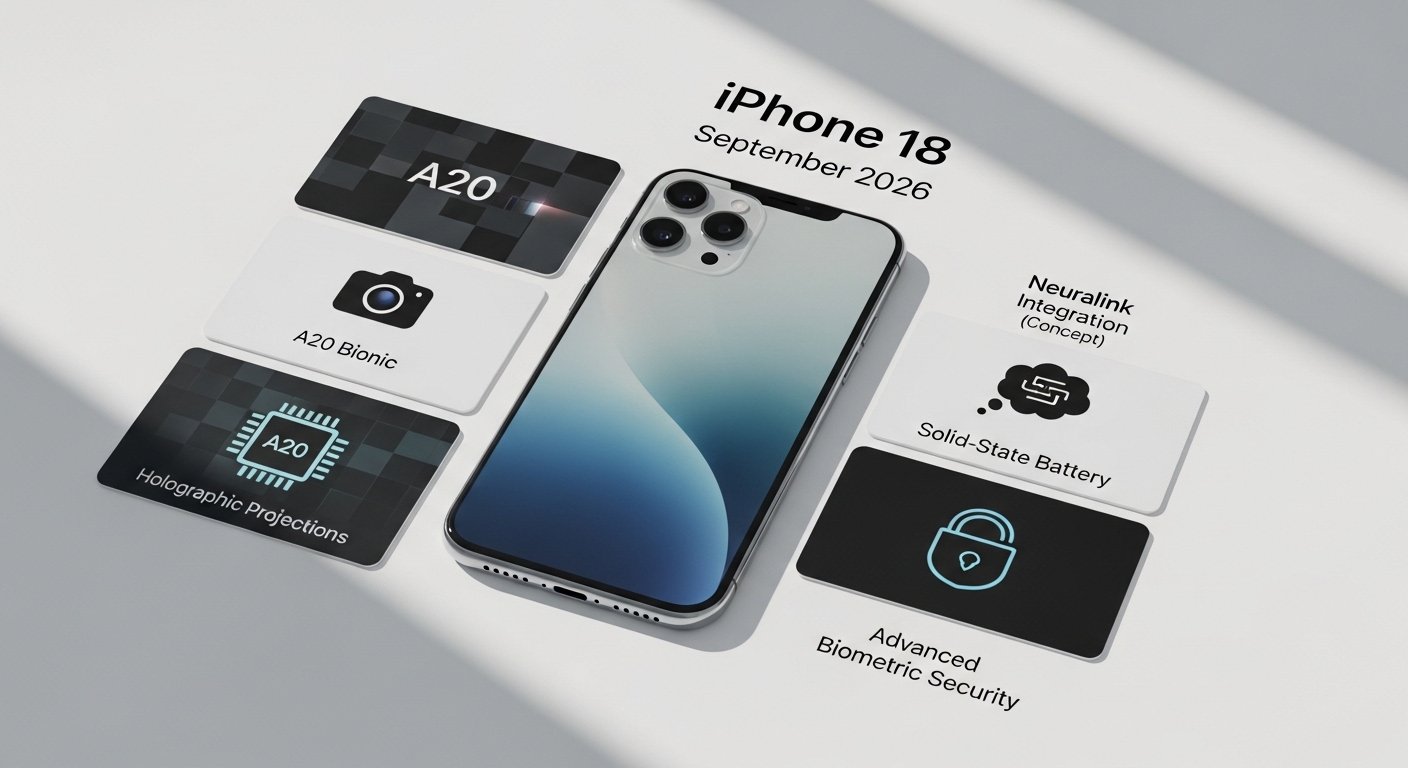
For most years, the iPhone’s chip upgrade is the most reliable predictor of real-world improvements, even when the design looks familiar. MacRumors says iPhone 18 Pro models and the foldable iPhone are expected to use Apple’s A20 chip, and it outlines expectations around a move to TSMC’s 2nm process for power and efficiency gains.
The same roundup suggests the 2nm transition could allow higher transistor density, and it cites claims of performance and efficiency improvements relative to A19-generation chips.
What does that mean in daily use?
Efficiency improvements tend to show up as steadier performance under load and less heat during camera use, navigation, and gaming. More headroom can also improve how consistently the camera processes images in difficult lighting, because computational photography is heavily chip-dependent.
AI features are likely to be part of the conversation as well, but the more practical story is battery stability: phones that run cooler typically drain more predictably over long sessions.
Front design: under-display Face ID talk returns
Front design rumors for iPhone 18 Pro models are increasingly tied to Face ID hardware placement. AppleInsider reports that display analyst Ross Young has suggested iPhone 18 Pro models are expected to feature Face ID beneath the display, while the front-facing camera would remain visible.
MacRumors echoes the uncertainty, describing disagreements across sources about whether under-display Face ID will arrive in 2026 and what that means for the future of the Dynamic Island.
Why this matters beyond aesthetics
Reducing cutouts can improve perceived screen continuity, but Apple will prioritize reliability and security for Face ID. AppleInsider notes that Apple is unlikely to adopt under-display Face ID if it compromises security or user convenience.
If under-display Face ID arrives, a “smaller Dynamic Island” or a single camera hole-punch outcome would likely be more realistic than a fully uninterrupted display in the near term.
Camera expectations: more control, more consistency
Camera upgrades expected for iPhone 18 Pro models are being framed as a mix of hardware and control features, not just higher megapixel counts. MacRumors says the main camera on iPhone 18 Pro could get a variable aperture, which would allow manual adjustment of how much light reaches the sensor.
The same roundup also references the possibility of a new stacked image sensor developed by Samsung for at least one Pro model, and it suggests potential changes to apertures on main and telephoto lenses to improve low-light performance.
What would count as a real upgrade
- Sharper indoor photos with fewer blurred frames, especially for moving subjects.
- More consistent exposure and color when switching between lenses.
- Better low-light video stability with less noise and fewer focus hunts.
- More predictable portrait results at 2x–5x, where many people shoot portraits.
Camera gains also depend on the chip. If A20 efficiency and performance improvements land as expected, computational photography improvements could be more noticeable than a simple spec-sheet change.
Connectivity: modem upgrades and satellite talk
Modern changes are often invisible until they improve battery life on mobile data or reduce dead spots. MacRumors says a next-generation “C2” modem is expected in 2026 and could be more capable than Apple’s earlier modem efforts, including mention of mmWave 5G support and satellite-related possibilities.
For everyday users, the real impact would be steadier performance in weak-signal areas and less battery drain during travel, hotspot use, and long navigation sessions.
Display and durability expectations
Display rumors in early cycles tend to be less precise, but the direction is consistent: brighter screens, improved efficiency, and refinements to the viewing experience. MacRumors notes claims that iPhone 18 will feature an “improved display,” with unusually high brightness requirements mentioned in its roundup.
Durability talk is more prominent for a foldable model than for the standard slab iPhones. MacRumors describes Apple’s foldable design as book-style and discusses crease-minimization as a priority, including hinge material claims and an emphasis on reducing visible creasing.
Price expectations (and why they’re hard to pin down)
Prices are difficult to predict early, but component shifts can influence strategy. MacRumors notes claims that 2nm chip pricing could be higher than prior nodes, and it also discusses how that cost could affect which models receive the most advanced silicon.
If Apple truly adopts a split launch, pricing pressure may increase on the fall lineup because it would skew premium. That could make trade-in offers and carrier promos more important than ever for buyers who upgrade on schedule.
Should waiting for iPhone 18 make sense?
Waiting makes the most sense when the rumored changes solve a specific pain point: wanting a smaller front cutout, wanting better battery stability under heavy use, or wanting a more reliable camera experience in indoor and night conditions.
Upgrading earlier can still be rational when a strong deal lowers the effective price significantly, especially if the phone being replaced is already struggling with battery health or storage pressure.
What to watch next
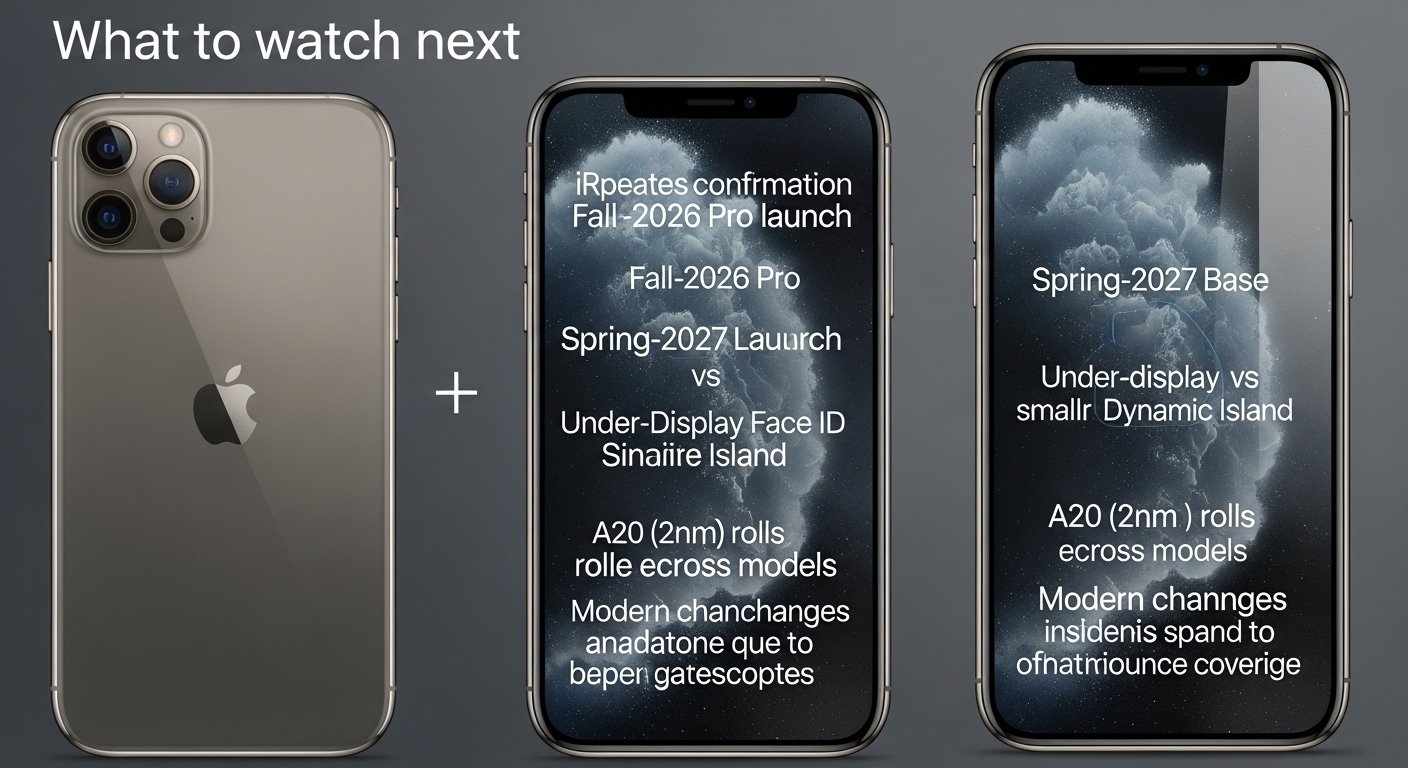
The iPhone rumor cycle becomes more useful when it shifts from concept claims to supply-chain patterns and repeated reporting on the same details. For iPhone 18, the key things to watch are whether the split launch timeline continues to be reinforced and whether under-display Face ID reports solidify into a consistent story across multiple sources.
-
- Repeated confirmation of a fall-2026 Pro launch plus a spring-2027 base launch.
-
- Clearer consensus on under-display Face ID vs a smaller Dynamic Island.
-
- More concrete details on A20 (2nm) rollout across models.
-
- Evidence of modern changes and what they mean for battery and coverage.
Read more (Phone Expertise)
Read more on Phone Expertise: Upcoming Samsung phones to watch.
Explore related coverage: Samsung flagship vs mid-range comparison.
Further analysis available here: Samsung battery improvements in 2026.
FAQ
When is the iPhone 18 expected to launch?
Current roundup reporting points to iPhone 18 Pro models launching in fall 2026, while the regular iPhone 18 could move to spring 2027 as part of a split release cycle.
Is Apple really planning a foldable iPhone for the iPhone 18 era?
Multiple rumors summarized in major roundups suggest Apple’s first foldable iPhone could launch in fall 2026 alongside iPhone 18 Pro models.
Will iPhone 18 Pro get under-display Face ID?
Under-display Face ID remains a rumor, but reporting citing display analyst Ross Young suggests iPhone 18 Pro models could move Face ID components under the display while keeping the selfie camera visible.
What is the expected iPhone 18 chip?
Roundup reporting says iPhone 18 Pro models are expected to use Apple’s A20 chip, with discussion centered on a 2nm manufacturing process and potential performance/efficiency gains.
What are the most likely “real-world” upgrades for iPhone 18?
The most meaningful upgrades are expected to be efficiency and consistency: steadier battery life on mobile data, better thermals under load, more reliable indoor photos, and front design refinements on Pro models.
