
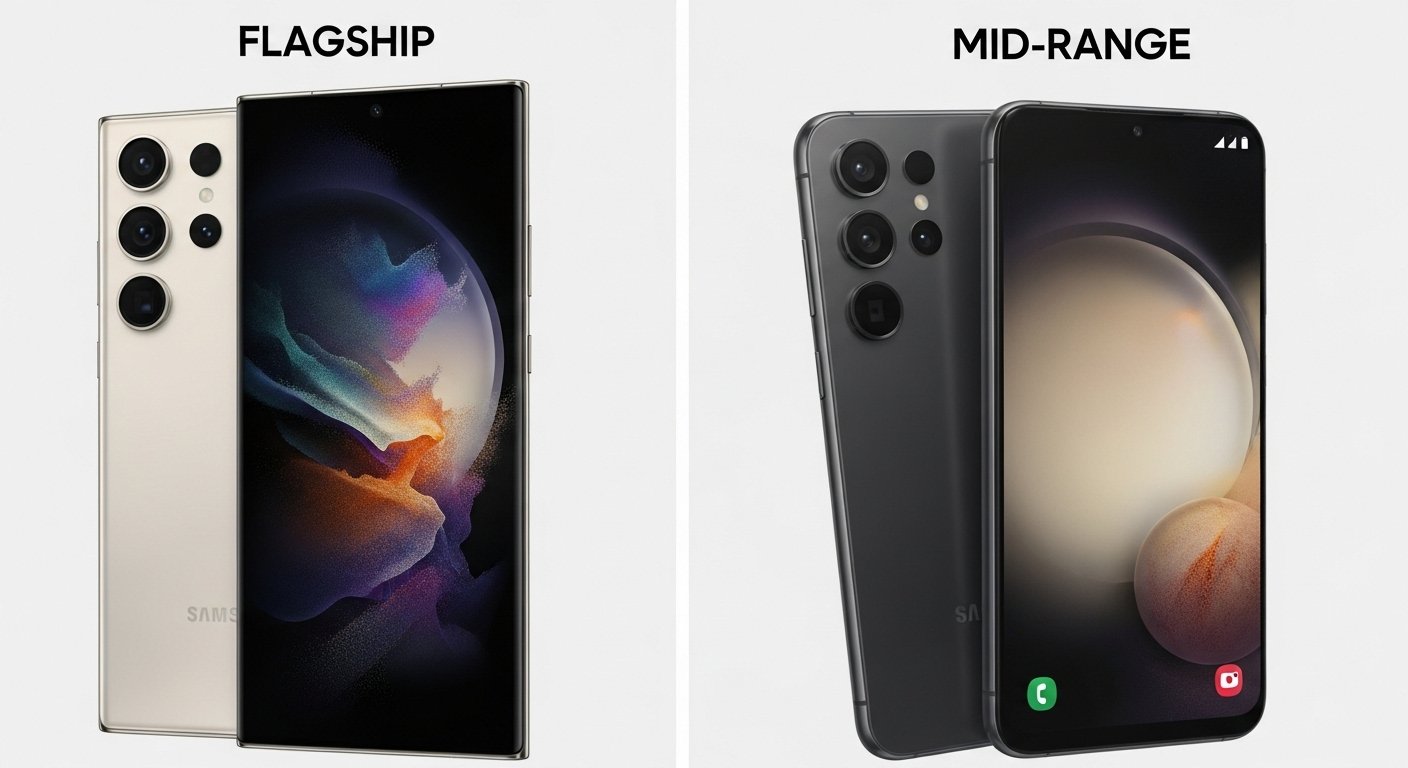
Samsung flagship vs mid-range comparison comes down to one question: which compromises are acceptable for the price?. Flagships deliver the most consistent cameras, the strongest sustained performance, and the most “premium” polish, while mid-range models focus on battery comfort, big screens, and strong everyday value.
Flagship vs mid-range: key differences
| Category | Samsung flagships (Galaxy S / Ultra / Foldables) | Samsung mid-range (Galaxy A tiers) | What it means in real use |
|---|---|---|---|
| Performance | Top-tier chipsets, stronger thermal design | Balanced chipsets tuned for efficiency and cost | Flagships stay smoother under heavy load; mid-range is excellent for typical apps.s |
| Camera consistency | Better low light, faster capture, stronger zoom, and video | Great daylight photos, mixed indoor results vary by tier | Flagships deliver fewer “missed shots,” especially at night and indoors |
| Display quality | Higher peak brightness, better calibration, premium glass | Large screens, often excellent AMOLED on higher A tiers | Flagships win outdoors and in HDR; mid-range can still look impressive indoors |
| Build & durability | More premium materials, stronger finishing details | More cost-efficient materials, durability varies by model | Flagships feel more “solid” and age better cosmetically |
| Battery experience | Efficient under load, strong standby, sometimes smaller cells | Often larger batteries, strong endurance at light-to-medium use | Mid-range can last longer in light use; flagships are steadier on heavy days |
| Software features | Most features arrive first, deeper camera and productivity tools | Core One UI features, some premium toolsare limited by tier | Flagships get the most complete feature set; mid-range prioritizes essentials |
| Value | Best overall experience, highest price | Best price-to-performance, lower peak capability | Mid-range wins value; flagships win “no compromises” use |
Performance: burst speed vs sustained smoothness
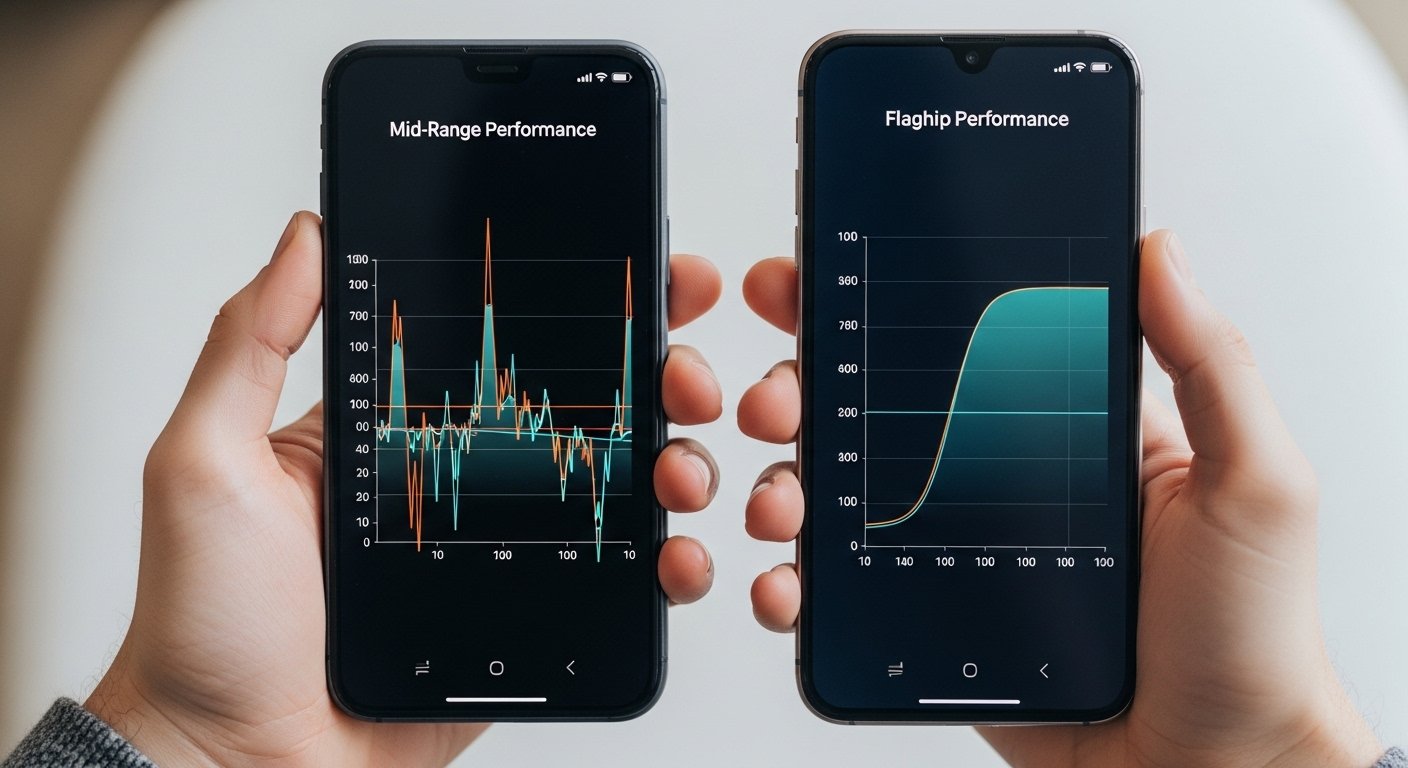
Modern mid-range Galaxy phones are fast enough for everyday life: social apps, browsing, streaming, navigation, and messaging. The flagship advantage becomes obvious when the workload stays heavy for longer—4K video recording, long gaming sessions, multi-app productivity, and intense camera processing.
That difference is less about raw benchmark numbers and more about stability. Flagships tend to maintain performance with fewer heat spikes and fewer slowdowns, which keeps the phone feeling consistent for longer ownership.
Who benefits most from flagship performance?e
- Mobile gamers who play demanding titles for long sessions.
- Creators who shoot and edit video on the phone.
- People who rely on DeX-style workflows, multitasking, or heavy productivity apps.
- Users who keep a phone for years and want maximum “performance headroom.”
Who can safely choose mid-range performance
- Typical app usage: messaging, social, camera, streaming, light editing.
- Users who prefer longer battery comfort over top-end speed.
- Buyers who upgrade more frequently and prioritize value per dollar.
Cameras: the biggest reason to buy a flagship
Camera comparisons often get stuck on megapixels, but everyday camera quality is about reliability. Flagships usually capture faster, handle motion better, and deliver cleaner low-light photos with less noise and less blur. Mid-range models can be excellent outdoors in good light, but they are more likely to struggle indoors, at night, and when subjects move.
Video is where the gap often feels widest. Flagships tend to deliver steadier stabilization, more consistent exposure changes, and stronger autofocus confidence across lenses.
What to expect from mid-range cameras
- Strong daylight photos, especially at 1x.
- Portrait mode looks good when the lighting is clean.
- More variability in indoor shots, especially with motion.
- Zoom is fine for short ranges, but less dependable at longer ranges.
What to expect from flagship cameras
- More consistent results across lighting conditions.
- Better indoor motion handling (fewer blurred frames).
- Stronger zoom quality (optical telephoto advantages).
- More reliable video for travel and events.
Displays: great panels are common, but premium tuning is not
Mid-range Samsung phones can have impressive displays, especially on the higher Galaxy A tiers. Large screens, good color, and smooth scrolling are now widely available. The flagship advantage is typically brightness, reflection handling, HDR punch, and overall “visual confidence” outdoors.
For heavy outdoor use—navigation, travel photography, and bright sunlight—flagships remain easier to read. For indoor use, a strong mid-range AMOLED can feel close to flagship quality in many situations.
Display priorities that matter more than resolution
- Outdoor brightness and readability.
- Adaptive refresh behavior that keeps scrolling smooth without draining battery.
- Touch response and stability during gaming and typing.
- Uniform brightness and fewer color shifts at angles.
Battery: mid-range can win, flagships can be steadier
Mid-range Galaxy phones often deliver excellent endurance because they pair large batteries with efficient hardware. For many users, that translates to easy all-day use with plenty of remaining charge, particularly on Wi‑Fi and light-to-medium workloads.
Flagships can still win in the “worst-case day” scenario—heavy mobile data, navigation, camera use, and multitasking—because efficiency and thermal control under load can prevent battery drain spikes.
Battery decision rule that works for most buyers
- Light-to-medium use and long endurance priority: mid-range is often the better value.
- Heavy use, long camera sessions, frequent navigation: a flagship can feel more stable and predictable.
Build quality: the premium feel is real (and it ages better)
Samsung’s flagships usually deliver stronger build materials, better haptics, more refined buttons, and a higher-end “feel” that remains satisfying over time. Mid-range devices can still be well-built, but they often prioritize cost-efficient materials and simpler finishing details.
This category matters most for long-term ownership. Flagships tend to hold up better cosmetically and feel more “new” after years of use, especially when paired with strong repair and accessory ecosystems.
Software features and support: essentials vs the full experience
Samsung’s One UI experience is generally consistent across tiers, but premium features tend to arrive first on flagships and remain more complete there. That can include camera tool depth, productivity enhancements, and certain AI features that depend on newer hardware.
Mid-range models still receive the core One UI experience that defines daily use: customization, privacy controls, productivity basics, and Samsung’s ecosystem tools. The practical difference is usually “how many extras” appear and how smoothly the phone runs those extras under load.
Cost and value: where mid-range makes the most sense
Mid-range phones are often the smartest buys because they deliver the majority of what people actually use at a much lower cost. Value becomes even stronger when promotions are available, especially if the phone is purchased unlocked or through a carrier deal that doesn’t force an expensive long-term plan.
Flagships make sense when the price buys meaningful daily benefits: camera reliability, video quality, sustained performance, premium display behavior, and fewer compromises over years of ownership.
Pros and cons
Samsung flagships: pros
- Most consistent cameras across lighting conditions.
- Best video quality and stabilization.
- Stronger sustained performance and thermal stability.
- Premium display behavior, especially outdoors.
- Higher-end build quality and long-term polish.
Samsung flagships: cons
- Higher upfront price.
- Value depends heavily on promotions and trade-ins.
- Some models prioritize thinness and performance, not maximum battery capacity.
Samsung mid-range: pros
- Excellent value for typical daily use.
- Often, strong battery endurance.
- Large screens and smooth displays on many models.
- Lower replacement cost and broader budget fit.
Samsung mid-range: cons
- Indoor and night camera reliability varies by tier.
- Zoom and video consistency are usually behind flagships.
- Less performance headroom for heavy use over multiple years.
Who should buy which
Choose a Samsung flagship if
- Camera and video reliability matter more than saving money.
- Heavy usage is normal: long navigation, frequent gaming, multitasking, or editing.
- The phone is used for work-critical tasks and needs maximum stability.
- Long ownership is the plan,n and a premium experience is the goal.
Choose a Samsung mid-range if
- Battery endurance and value are the top priorities.
- Most photos are taken in good light,t and zoom is not a major need.
- A large, smooth display matters more than peak brightness and premium materials.
- Budget is firm,m and the goal is the best experience per dollar.
Buying verdict
Samsung’s mid-range phones are the better choice for most people because they deliver a modern smartphone experience at a far more reasonable price. Samsung’s flagships are the better choice for people who care about camera reliability, video quality, outdoor display strength, and sustained performance under heavy use.
The most common “smart buy” outcome is simple: pick mid-range for value and battery comfort, pick flagship for cameras and long-term premium polish.
Where to Buy
Carrier deals can make a flagship surprisingly affordable through trade-ins and monthly credits, but the fine print matters. Unlocked purchases can offer more flexibility for travel, switching carriers, and long-term ownership. Retailers often run storage promotions and bundle offers that shift the real value more than a small spec difference.
For mid-range phones, the best value usually comes from seasonal discounts or stepping up one tier when promotions narrow the price gap.
Related Articles
Read more on Phone Expertise: Samsung battery improvements in 2026.
Explore related coverage: Samsung camera upgrades explained.
Further analysis available here: Best Samsung budget phones in 2026.
FAQ
What is the main differencebetween Samsung’sg flagship and mid-range phones?
Flagships prioritize camera consistency, sustained performance, premium display behavior, and high-end build quality. Mid-range phones prioritize battery comfort and value, while still delivering a strong everyday experience.
Are Samsung mid-range phones good enough in 2026?
Yes,s for most everyday use. Mid-range models handle common apps smoothly and often deliver strong endurance, with the biggest compromises typically appearing in low-light photography, zoom quality, and heavy sustained workloads.
Is it worth paying extra for a Galaxy S Ultra instead of a Galaxy A phone?
It’s worth it when camera and video reliability, outdoor display performance, and long-term premium polish are priorities. It’s less worth it when the main use is messaging, streaming, browsing, and casual photography in good light.
Which lasts longer: Samsung flagship or mid-range?
Flagships usually have more performance headroom and feel smoother for longer under heavy use. Mid-range phones can still last for years, but long-term satisfaction depends more heavily on storage choice, battery health, and camera expectations.
What should be prioritized on a Samsung mid-range phone?
Storage, display smoothness, and battery comfort tend to deliverthe greatestt day-to-day satisfaction. Camera expectations should focus on indoor reliability rather than megapixels.
